
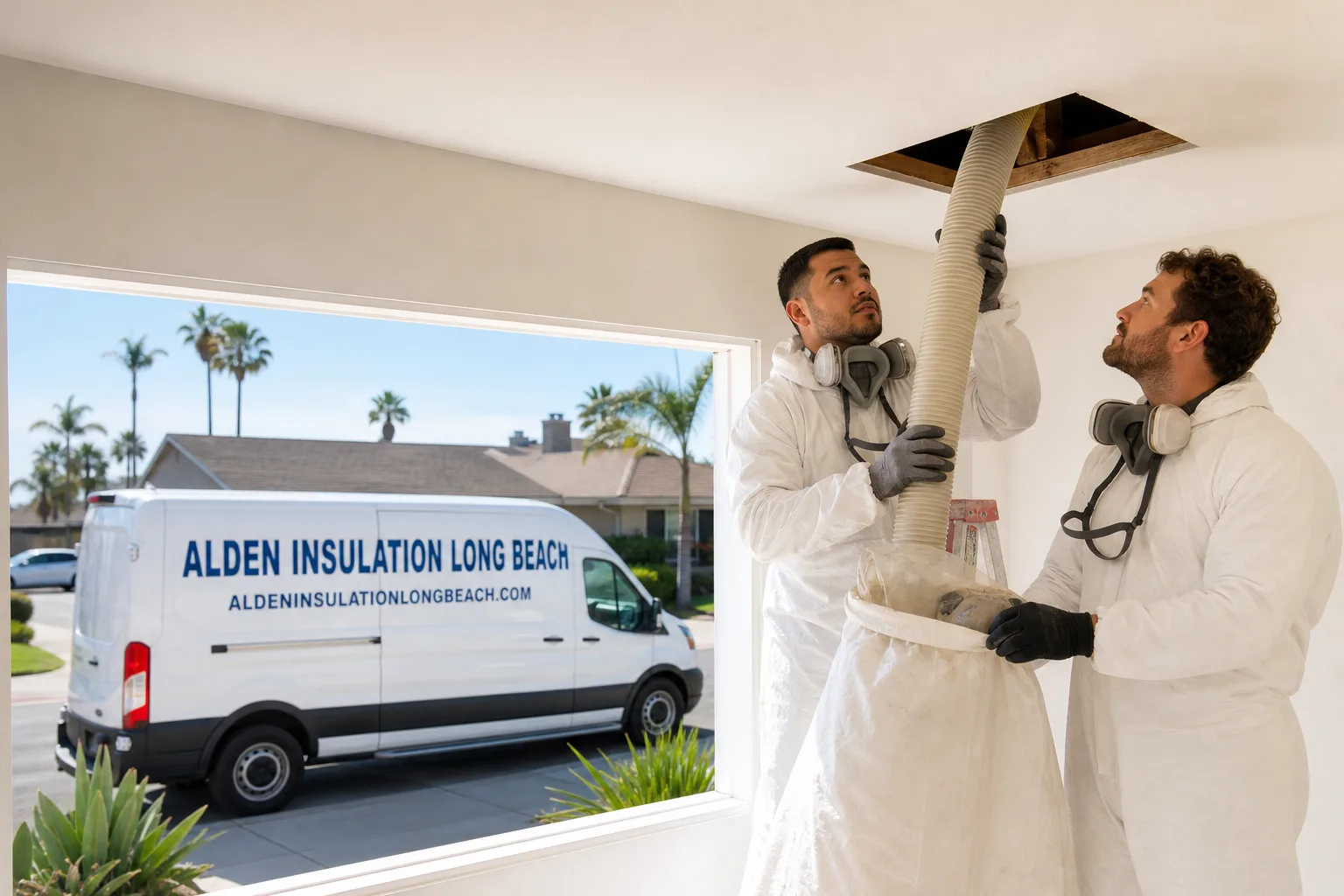
How Much Does Insulation Removal & Replacement Cost in Long Beach?
Insulation removal and replacement in Long Beach typically costs between $2,800 and $7,500 for a standard 1,500-square-foot attic, with most homeowners paying around $4,600. The job usually takes one to two days when a professional crew handles it. Prices shift based on attic size, the condition of the existing insulation, and whether you’re upgrading to a higher R-value material.
Those numbers cover the full scope: removing old insulation, disposing of it, air sealing, and installing new material. If you’re only removing insulation without replacing it, expect to pay $1,200 to $3,000 for the same attic size.
Insulation Removal & Replacement Cost Breakdown (2026)
Here’s what each part of the job costs in the Long Beach market right now. These are the numbers we quote from when homeowners call asking for a ballpark before scheduling an estimate.
| Service Component | Typical Cost Range (Long Beach, 2026) | Notes |
|---|---|---|
| Insulation removal (1,500 sq ft attic) | $1,200 – $3,000 | Includes bagging, vacuuming, and disposal |
| Blown-in fiberglass installation | $1,800 – $3,400 | R-38 to R-60, depending on depth |
| Blown-in cellulose installation | $2,200 – $4,000 | Higher R-value per inch than fiberglass |
| Spray foam (open-cell) | $3,500 – $6,500 | For attics being converted to living space |
| Spray foam (closed-cell) | $5,000 – $9,000 | Highest R-value per inch; moisture barrier |
| Air sealing (attic floor) | $400 – $1,100 | Sealing penetrations before new insulation goes in |
| Rodent damage repair / sanitization | $500 – $2,000 | Common in older Long Beach attics near the coast |
Those are honest ranges, not teaser numbers. The variables that push you toward the top or bottom of each range come down to attic accessibility, how much old material has to come out, and what’s actually up there once we look. A 1920s craftsman in Belmont Heights with a low-pitch roof and three layers of old insulation is a different job than a 1990s tract home in Los Altos with clean fiberglass batts.
Why the range is wide
The single biggest cost driver is removal complexity. If the old insulation is dry, loose, and comes out with a commercial vacuum in a few hours, removal stays cheap. If it’s compacted, wet from a roof leak, or full of rodent droppings in a tight attic with no walkway, the labor hours climb fast. Long Beach humidity near the coast means attics in neighborhoods like Naples and Belmont Shore see more moisture-related insulation breakdown than homes further inland in Bixby Knolls or Lakewood Village.
Material choice is the second driver. Blown-in fiberglass from Owens Corning or Johns Manville runs less per square foot than Rockwool or CertainTeed, and all of those cost significantly less than spray foam from Icynene or Demilec. None of them are bad products. They serve different attics and different budgets.
What Affects Insulation Removal & Replacement Pricing in Long Beach
- Attic square footage and layout. A 900-square-foot attic in a Wilmington bungalow costs less than a 2,300-square-foot attic in a Park Estates ranch. The math is straightforward, but layout matters too. Attics with multiple knee walls, dormers, and tight clearance require more labor hours than one open rectangle.
- Current insulation condition. Wet, moldy, or pest-damaged insulation takes longer to remove and requires proper disposal. Long Beach’s marine layer means morning moisture is a constant factor, and attics that were never properly vented trap that moisture against the insulation for decades.
- R-value target. California building code (Title 24) recommends R-38 to R-60 for attics in the Long Beach climate zone. Going from R-19 to R-49 means more material and more labor. The higher the R-value, the better the thermal barrier, and the higher the price.
- Access and safety. Attics with a proper access hatch, decked flooring, and adequate headroom are faster to service. Attics with a 14-inch scuttle hole, no lighting, and exposed trusses slow everything down. Some older Long Beach homes built before 1950 have only crawl-space attic access, which adds hours to the removal process.
- Air sealing scope. If the home has dozens of unsealed penetrations (ceiling light fixtures, plumbing vents, wiring chases, interior wall top plates), the air sealing work grows. Air sealing is the part of the job that delivers the most long-term comfort benefit per dollar, and it’s worth doing while the attic is empty.
- Disposal and environmental fees. Long Beach disposal costs run slightly higher than inland cities because haul distance to approved facilities is longer. Contaminated insulation (rodent waste, mold) requires specialized handling that adds to the total.
What Alden does differently on pricing
Alden Attic Insulation operates under The Garrison Standard, which means one thing for pricing: the written price is in your hand before a single tool comes off the truck. No revised estimate at the door, no upcharge discovered at invoice time. Bryce Holloway, who leads Alden Insulation Long Beach, built the crew around a simple rule – if the scope doesn’t change, the number doesn’t change. That’s not a sales pitch. It’s how The Garrison Code has operated since 2002, and it applies to every insulation removal and replacement job in Long Beach.
How to Save on Insulation Removal & Replacement
There are ways to keep this project affordable without cutting corners on materials or labor. Here’s what actually moves the needle.
- Bundle removal with replacement. If you’re already paying for the crew to be on site with the vacuum and disposal bags, adding new insulation installation at the same time is cheaper than doing it as two separate jobs later. You save on mobilization, setup, and disposal coordination.
- Ask about air sealing while the attic is empty. Air sealing costs $400 to $1,100 on its own. Doing it while the attic is already stripped saves you from paying someone to move new insulation aside later. This is the single best value-add available on this project.
- Check for utility rebates. Southern California Edison and Long Beach Energy Resources occasionally run insulation rebate programs. Eligibility changes by year, but a 10-minute phone call can save $300 to $800 on qualifying upgrades. The materials from Knauf, GreenFiber, and CertainTeed all qualify under most program specs.
- Time the project outside peak season. Insulation contractors in Long Beach are busiest June through September, when homeowners finally notice how hot their upstairs gets. Scheduling removal and replacement for October through April often means faster scheduling and occasionally lower labor rates.
- Get a real written estimate, not a verbal ballpark. Verbal estimates leave room for revision. A written, itemized price locks in the number. Alden provides written pricing on every job before any work begins. To get a free estimate for your attic, call (562) 317-6204.
Is Insulation Removal Always Necessary?
Not always. If the existing insulation is dry, free of pests, and still at a reasonable R-value for its type, you may not need full removal. Adding new blown-in insulation on top of old is sometimes a viable option.
But there are conditions where removal is the right call, not an upsell:
- Rodent or pest infestation. Attics in Long Beach’s older neighborhoods (Rose Park, Eastside, Wrigley) see more rodent activity than newer developments. Rat droppings and urine in insulation create a health hazard that can’t be sealed over. The material has to come out, and the attic needs sanitization before new insulation goes in.
- Water damage or mold. A slow roof leak or a bathroom exhaust fan venting into the attic instead of outside can soak insulation over months. Wet insulation loses its R-value fast and breeds mold. It comes out.
- Code or safety issues. Vermiculite insulation in homes built before 1990 may contain asbestos. If testing confirms it, removal requires a licensed abatement contractor, not a standard insulation crew. We’ll tell you if this applies to your home and point you in the right direction.
- Electrical work in the attic. If you’re rewiring or adding recessed lights, old insulation often has to come out first. It’s easier and safer to remove material, do the electrical work, then blow in fresh insulation.
- Severe compaction. Insulation that has been walked on, water-damaged, or simply aged can compress to a fraction of its original thickness. Compacted insulation doesn’t insulate. In Long Beach’s climate, where attics can hit 130 degrees in August, compacted R-30 fiberglass performs closer to R-15.
If you’re not sure whether your attic needs full removal or can get by with a top-up, the honest move is to have someone look at it. Alden’s technicians are background-checked, uniformed, and trained to tell you what you actually need, not what pads the invoice. Call (562) 317-6204 and we’ll schedule an attic inspection.
Insulation Materials: What Goes Back In
Once the old material is out, you have a real decision to make about what replaces it. Every material has a place, and the right choice depends on your attic, your budget, and how you use the space.
Blown-in fiberglass
The workhorse option. Owens Corning and Johns Manville both make blown-in fiberglass that installs fast and performs well in ventilated attics. It runs $1,800 to $3,400 for a typical Long Beach attic at R-38 to R-49. It settles slightly over time, but properly installed fiberglass with adequate depth is the best price-to-performance ratio for most homes.
Blown-in cellulose
GreenFiber cellulose is made from recycled paper treated with borate for fire and pest resistance. It costs slightly more than fiberglass ($2,200 to $4,000) but delivers a higher R-value per inch, which matters in attics with limited cavity depth. Cellulose also does a better job filling odd-shaped cavities and blocking air movement.
Rockwool (mineral wool)
Rockwool is a premium option at $3,000 to $5,500 for a standard attic. It’s fire-resistant up to 2,000 degrees Fahrenheit, repels water, and doesn’t sag or settle. In Long Beach, where coastal moisture is a constant, Rockwool makes sense for attics that run damp regardless of ventilation improvements.
Spray foam (open-cell and closed-cell)
Spray foam from Icynene or Demilec seals and insulates at the same time. Open-cell runs $3,500 to $6,500 and is the right choice for attics being converted into living space. Closed-cell runs $5,000 to $9,000 and provides both an air barrier and a vapor barrier. It’s the most expensive option by a wide margin, and it’s overkill for most ventilated attics where blown-in material does the job at half the price.
Alden installs all of these materials. That’s not a marketing line – it means when we walk your attic, we can tell you which material fits your house without trying to fit your house to the one material we happen to stock. You can research every brand we use before you say yes: Owens Corning, Johns Manville, Knauf, Rockwool, CertainTeed, Icynene, Demilec, and GreenFiber.
R-Value: What Long Beach Homes Actually Need
R-value measures thermal resistance – how well the insulation resists heat flow. Higher R-value means better insulation. California’s Title 24 building code recommends R-38 to R-60 for attics in Long Beach’s climate zone (zone 6). For most existing homes, R-38 is the code minimum for new work, and R-49 is the sweet spot between performance and price.
Here’s what that means in practical terms:
- R-38: About 12 to 14 inches of blown-in fiberglass. Meets minimum code. Noticeable improvement for most older homes.
- R-49: About 16 to 18 inches of blown-in fiberglass. Best value. This is what we recommend for most Long Beach attics.
- R-60: About 20 to 22 inches of blown-in fiberglass. Maximum efficiency for ventilated attics. Makes sense if you run air conditioning heavily or have a second-floor master suite that bakes in summer.
Long Beach is a cooling-dominated climate. The attic is the single biggest source of heat gain in summer – on a 90-degree day, an under-insulated attic can reach 140 degrees, and that heat radiates down into your living space for hours after sunset. Upgrading from R-19 to R-49 can cut attic-to-home heat transfer by more than half, which shows up on your SCE bill from June through October.
Signs Your Insulation Needs Replacement
Insulation doesn’t have an expiration date, but it does fail. Here’s what tells you it’s time to call for an inspection:
- Rooms that won’t hold temperature. The upstairs is 10 degrees warmer than downstairs in summer, or the whole house feels cold in January despite the heater running. Old or compacted insulation is usually part of the story.
- Mystery drafts. Air leaks through the attic floor bypass whatever insulation is up there. You feel air moving in the house when the furnace kicks on, or you smell outside air inside.
- Energy bills climbing. If your SCE bill is up year over year without a change in usage habits, the thermal envelope is degrading somewhere. Attics are the usual suspect.
- Pest noise or evidence. Scratching overhead, droppings in the attic, or visible trails through the insulation. Pests ruin insulation and the problem only compounds.
- Water staining on ceilings. A roof leak often soaks the insulation before the water reaches drywall. By the time you see a stain, the insulation above it is usually done.
- Ice-cold walls or hot ceilings. In Long Beach’s mild winters, this is less common than in colder climates, but it still indicates missing or failed insulation in specific areas.
If you’re noticing any of these, the first step is an attic inspection, not a full replacement quote. Sometimes the problem is a single vented soffit that got blocked or a bathroom fan venting into the attic. A disciplined inspector finds the problem without selling you a solution you don’t need.
FAQs – Insulation Removal & Replacement Cost
How much does insulation removal cost per square foot in Long Beach?
Insulation removal in Long Beach runs $0.80 to $2.00 per square foot for standard blown-in or batt material, including disposal. A 1,500-square-foot attic lands between $1,200 and $3,000. Removal only (no replacement) skews toward the lower end. Contaminated material – rodent waste, mold, or water damage – pushes the per-square-foot cost up because of the extra handling and disposal requirements. For an exact quote on your attic, call (562) 317-6204.
Is it cheaper to remove old insulation or blow new insulation over it?
Blowing new insulation over old is always cheaper, running $1,500 to $3,000 for a typical Long Beach attic versus $2,800 to $7,500 for full removal and replacement. But cheaper isn’t always correct. If the existing insulation is wet, pest-infested, or moldy, covering it doesn’t fix the problem – it hides it. If the old insulation is dry and in acceptable condition, topping up is a legitimate option. A proper attic inspection answers this question in 20 minutes.
How long does insulation removal and replacement take?
Most Long Beach attic removal and replacement jobs take one to two days for a two-person crew. Small attics (under 1,000 square feet) can finish in a single day. Larger attics, contaminated insulation, or shallow-access attics add time. The 365-Day Done Right Promise from Alden covers the work in writing for a full year – if anything fails in that period, we return at no charge.
What does it cost to remove rodent-contaminated insulation in Long Beach?
Rodent-contaminated insulation removal in Long Beach runs $2,500 to $5,000 depending on attic size and contamination severity. This includes full material removal, bagging, sanitization of the attic surface, and sometimes deodorizing treatment. It’s a bigger job than clean removal because of the protective gear, specialized disposal, and the sanitation pass. Older Long Beach neighborhoods like Rose Park and Wrigley see this more often than the newer developments east of Lakewood Boulevard. Call (562) 317-6204 for an assessment and written price.
Does new insulation pay for itself in Long Beach energy savings?
For a typical Long Beach home going from R-19 to R-49, the annual SCE savings run $250 to $600 per year. That puts the payback period on a $4,600 removal and replacement job at roughly 8 to 15 years for energy savings alone. But energy savings aren’t the whole return – comfort, temperature consistency, and pest reduction all factor in. Homes in cooling-dominated neighborhoods like Los Altos and El Dorado Park see the biggest summer cooling savings.
Can you come out today to look at my insulation?
We answer calls with a live person, 24/7, and we can usually get a technician out for an attic inspection within one to two days. Same-day visits are available depending on scheduling. The inspection is free, and you’ll get a written estimate before any work is proposed. Call (562) 317-6204 at any hour – you won’t get a voicemail.
Get a Written Estimate for Insulation Removal in Long Beach
If your attic is underperforming, the only way to know what you’re dealing with is to look at it. Alden Insulation Long Beach provides free attic inspections and written estimates on every job. The number we put in your hand is the number on the invoice – that’s The Garrison Standard, and it’s been the operating rule since 2002.
Bryce Holloway and the Alden crew handle every insulation removal and replacement project in Long Beach with the same approach: show up inside the scheduled window, do the work by the book, and stand behind it in writing for 365 days. Our technicians are background-checked and uniformed. Our installs use materials from Owens Corning, Johns Manville, Knauf, Rockwool, CertainTeed, Icynene, Demilec, and GreenFiber. And our phones are answered by a real person, not a recording.
Call (562) 317-6204 or visit our home page to learn more. The estimate is free, the price is written, and the guarantee is for a full year.
Written by Bryce Holloway, Owner at Alden Insulation Long Beach, serving Long Beach and surrounding communities since 2002 under The Garrison Standard.
Pricing reflects the Long Beach market as of 2026. Alden Insulation Long Beach offers free estimates – call (562) 317-6204.
What Our Customers Say
"Blown-in insulation in the attic by a veteran crew. They air sealed the top plates first, installed baffles, and marked the depth with rulers. Bills dropped right away."
- Roy H."Removed rodent-damaged insulation, sanitized, and replaced it. Thorough and honest."
- Sue M."Spray foam in the rim joist. Floors above are warmer."
- Iris L.