
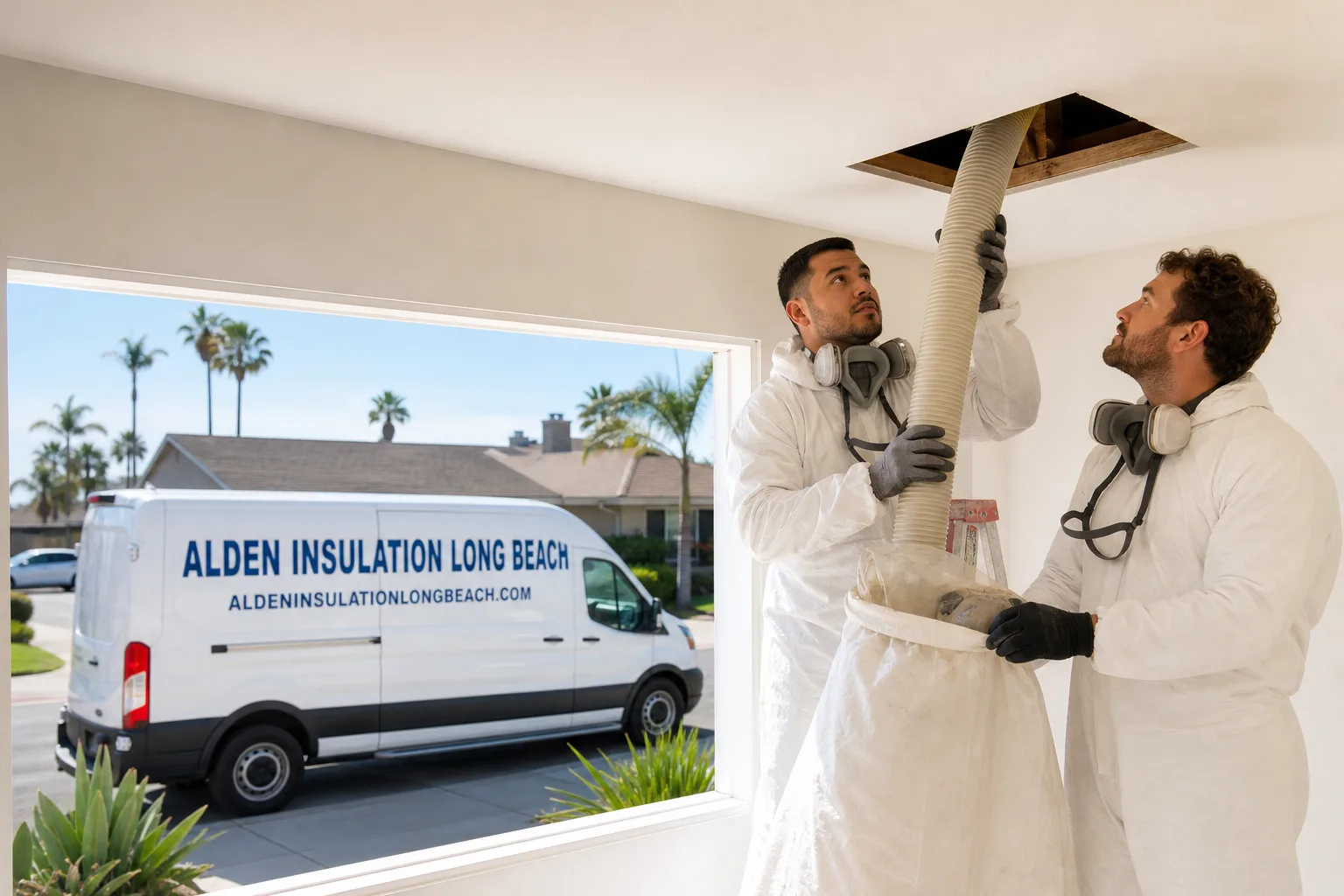
How Much Does Spray Foam Insulation Cost in Long Beach?
Spray foam insulation in Long Beach, CA typically costs $2,800 to $7,500 for a full attic installation in an average 1,500-square-foot home as of 2026. Smaller projects like rim joists or crawl space walls run $900 to $2,400, while whole-home retrofits with wall injection can reach $9,000 to $14,000. Closed-cell foam costs roughly $1.50 to $2.90 per board foot installed, and open-cell runs $0.70 to $1.40 per board foot.
Those are real numbers from the Long Beach market, not national averages. Our crews work in homes from Naples to Bixby Knolls to Los Altos, and the pricing we see lines up with what we’ve outlined below. The single biggest variable is square footage, followed by whether you’re insulating an open attic (simpler) or an enclosed wall cavity (more labor).
If you want a written price for your specific home, call (562) 317-6204. The estimate is free, and the number we put on paper is the number you’ll see on the invoice.
Spray Foam Insulation Cost Breakdown (2026)
Here’s what homeowners in Long Beach are paying for spray foam work in 2026, broken down by project type. These ranges reflect what we see across the city, from older 1940s bungalows in Rose Park to newer builds in East Long Beach:
| Project Type | Typical Cost Range (Long Beach, 2026) | What It Includes |
|---|---|---|
| Open-cell attic (full, 1,200 – 1,800 sq ft) | $1,800 – $3,600 | Spray application to roofline or attic floor, typically 5 – 6 inches |
| Closed-cell attic (full, 1,200 – 1,800 sq ft) | $4,200 – $8,400 | Spray application to roofline, typically 2 – 3 inches, includes vapor barrier properties |
| Crawl space walls (sealed encapsulation prep) | $1,400 – $2,800 | Closed-cell spray on band joists and foundation walls |
| Rim joist / band joist only | $900 – $1,800 | Closed-cell foam around the perimeter of the first floor |
| Wall cavity injection (existing home, per floor) | $3,500 – $7,500 | Drill-and-fill application through interior or exterior walls |
| Whole-home retrofit (attic + walls + crawl space) | $9,000 – $14,500 | Full thermal envelope treatment on a 1,500 – 2,200 sq ft home |
Per-board-foot pricing is the way most insulation contractors quote foam. In Long Beach, you’ll see $0.70 to $1.40 per board foot for open-cell and $1.50 to $2.90 per board foot for closed-cell, installed. A board foot is a 12-inch by 12-inch area, one inch thick. The thickness you need drives your total cost: a 6-inch open-cell application (roughly R-21 to R-23) uses six board feet per square foot of surface area.
What pushes a job toward the high end of those ranges? Access matters more than most homeowners expect. An attic with 4 feet of clearance at the peak is fast work. An attic with 18 inches of clearance and old blown-in that needs removal first is a different job entirely. In Long Beach’s older neighborhoods, especially Alamitos Beach and Belmont Heights, we regularly find attics that haven’t been touched since the 1960s, which means removal before installation.
What Affects Spray Foam Insulation Pricing in Long Beach
- Square footage and surface area. Foam is priced by board foot, which means the surface area you’re covering matters more than your home’s total square footage. A 1,200-square-foot house with a steep roofline can have more attic surface area than a sprawling 1,800-square-foot rancher.
- Open-cell vs. closed-cell. Closed-cell runs about twice the material cost of open-cell, but it delivers roughly R-6.5 to R-7 per inch compared to open-cell’s R-3.5 to R-3.8 per inch. Closed-cell also acts as an air and vapor barrier, which matters in Long Beach’s humid coastal months.
- Existing insulation removal. If you have old batt or blown-in insulation that needs to come out first, expect to add $1 to $3 per square foot for removal and disposal. In older Long Beach neighborhoods like Wrigley or North Long Beach, we find everything from fiberglass from the 1970s to materials that need proper remediation.
- Location of the work. Attics are straightforward. Crawl spaces in Long Beach’s older pier-and-beam homes add labor hours. Wall injection requires drilling through drywall or stucco and then patching, which adds $800 to $2,000 depending on the wall footage.
- Permit requirements. The City of Long Beach may require a building permit depending on the scope of your insulation project. Permit costs typically run $100 to $400, and a contractor who handles this process for you saves you time and uncertainty.
- Home age and construction style. Long Beach’s housing stock includes everything from 1920s Spanish bungalows to 1990s stucco tract homes. Older homes with knob-and-tube wiring in the attic require careful handling before foam touches the space, which adds preparation time and sometimes electrician coordination.
How to Save on Spray Foam Insulation
Spray foam is not the place to hunt for the lowest bid. The material chemistry matters, the application temperature matters, and a bad install is expensive to undo. But there are legitimate ways to keep the number reasonable without cutting corners:
- Air seal before you spray. If your attic has obvious air leaks around can lights, plumbing stacks, and wall top plates, sealing them first means you won’t use extra foam to compensate for gaps. Some projects need a separate air-sealing pass, which can actually reduce the overall foam thickness required.
- Consider open-cell in the attic, closed-cell in the crawl space. Open-cell performs well in vented attics and costs less. Closed-cell earns its keep in damp areas like crawl spaces, where its vapor-barrier properties justify the higher price. Mixing applications by location is a practical way to control cost.
- Time the project for the off-season. Insulation contractors in Long Beach swing from attic work in the spring and fall to urgent calls during the July-to-October heat. Scheduling your project in November through February often means faster availability and more scheduling flexibility, which can modestly affect price on larger jobs.
- Get a written, line-item estimate. You should know exactly what you’re paying for: how many board feet, what type of foam, how many inches, what prep work, what cleanup. At Alden Insulation Long Beach, the price you approve before work begins is the price on the final invoice. No revisions at the door, no “we found something unexpected” markup.
- Ask about the removal costs upfront. If you have existing insulation that needs to come out, getting that number early prevents an unpleasant surprise later in the process. We include removal and disposal in the written estimate, not as a “to be determined” line item.
The most direct way to know what your project will cost is to call us at (562) 317-6204. Tell us the square footage, the year your home was built, and what’s in the attic now. We’ll give you a free estimate based on the actual space, not a guess from a national pricing chart.
Open-Cell vs. Closed-Cell: What Should Long Beach Homeowners Choose?
The choice between open-cell and closed-cell foam is not just a cost decision. It’s a performance decision shaped by Long Beach’s specific climate: warm but not scorching summers, mild winters, and coastal humidity that sits over the city from June through early fall.
Open-cell foam costs less per board foot and does a solid job in vented attics where the primary goal is blocking radiant heat before it reaches your living space. It’s soft, it stays flexible, and it fills odd-shaped cavities well. Its R-value per inch is lower, which means you need more inches to hit the same thermal resistance. In a Long Beach attic with good ventilation, open-cell at 5 to 6 inches is a sensible, cost-effective choice.
Closed-cell foam delivers about twice the R-value per inch and acts as both an air and moisture barrier. In Long Beach’s coastal humidity, that moisture-barrier property is the reason we recommend closed-cell for crawl spaces and for any application where the foam contacts the exterior sheathing. It also adds structural rigidity, which some homeowners in older Long Beach neighborhoods appreciate when reinforcing pier-and-beam foundations.
The Long Beach building code has specific requirements for foam insulation, including thermal barriers and ignition barriers in certain applications. A licensed contractor will know these requirements and include compliance in the written estimate.
For a deep dive into how spray foam performs in this specific climate, read our full page on Spray Foam Insulation in Long Beach.
What About R-Value? What Should You Target in Long Beach?
R-value measures resistance to heat flow. Higher is better. The U.S. Department of Energy divides the country into climate zones, and Long Beach falls into Zone 3, which recommends R-30 to R-60 for attics in existing homes, R-13 to R-15 for wall cavities, and R-19 to R-25 for floors.
Here’s how that translates to spray foam thickness:
- To hit R-30 with open-cell (R-3.7 per inch): you need about 8 inches of foam.
- To hit R-30 with closed-cell (R-6.5 per inch): you need about 4.5 inches.
- To hit R-38 with open-cell: about 10 inches.
- To hit R-38 with closed-cell: about 6 inches.
Most Long Beach attics don’t need R-60. Our coastal climate stays moderate compared to inland cities like Temecula or the Inland Empire, where summer attic temperatures can hit 140 degrees. A properly applied 5 to 6 inches of open-cell or 2.5 to 3 inches of closed-cell on the roofline typically brings a Long Beach attic into the comfort zone, especially when combined with basic air sealing around penetrations.
That said, if your air conditioning runs constantly from June through October and your upstairs rooms never quite cool down, bumping to the higher end of the R-value range is worth the additional material cost. The foam pays back over time through reduced energy load, and here in Long Beach where SCE rates keep climbing, that payback window is getting shorter every year.
Is Spray Foam Worth the Cost Compared to Fiberglass or Cellulose?
This is the most common question we get from Long Beach homeowners who are comparing quotes. Spray foam costs 2 to 3 times more than blown-in fiberglass or cellulose upfront. So is it worth it?
For most Long Beach homes, the answer breaks down like this:
If your primary goal is reducing energy bills and improving comfort, a properly air-sealed attic with blown-in fiberglass or cellulose can get you 80% of the benefit of spray foam at roughly half the cost. Products like Johns Manville fiberglass or Knauf and GreenFiber blown-in insulation, installed at the right depth, deliver strong R-value per dollar.
If your goal is also to seal the home tightly against moisture and air infiltration, spray foam’s air-barrier properties are genuinely different from blown-in products. Fiberglass and cellulose slow heat transfer but do not stop air movement. Open-cell foam stops air movement well. Closed-cell foam stops both air and moisture movement. In a crawl space that gets damp in Long Beach’s marine layer months, closed-cell does things fiberglass cannot do.
If you live in an older Long Beach home with persistent drafts and dust, spray foam’s sealing ability may be the only thing that truly solves the problem. Blown-in insulation can look like a bargain until you discover that the air leaking through your wall top plates and recessed lights was the actual issue all along.
Does Spray Foam Insulation Need Replacing? How Long Does It Last?
Properly installed spray foam insulation lasts the life of the building. Unlike fiberglass batts that sag over time, compressed and rendered ineffective, closed-cell foam keeps its physical shape and R-value. Open-cell foam also holds its form, though it does not have the same moisture resistance as closed-cell.
The exceptions are installer error and physical disturbance. Foam that wasn’t mixed at the right temperature or ratio can cure improperly, leading to shrinkage, off-gassing odors, or poor adhesion. Foam that gets wet repeatedly because of a roof leak will eventually absorb moisture (especially open-cell). And any foam that’s physically pulled away during a remodel creates a thermal gap that should be addressed.
This is why the installer matters more than the brand on the barrel. A trained tech who follows the manufacturer’s temperature and substrate preparation requirements will produce a foam that performs for decades. A rushed application on a humid day or a dirty surface can fail within a year or two.
At Alden Insulation Long Beach, every installation carries our 365-Day Done Right Promise: a written guarantee valid for a full year after installation. If the work fails in that window, we return at no charge, period. That promise is what Bryce Holloway built our Long Beach operation on, and it’s non-negotiable in how we operate.
What Brands Do We Install? Why It Matters
The insulation industry has a wide quality gap between products. A homeowner who takes five minutes to research the material going into their attic is going to make a better decision than one who trusts the lowest bidder’s verbal assurance.
Here’s what we install and why these specific brands:
For spray foam: Icynene and Demilec. Both are Canadian manufacturers with decades of closed-cell and open-cell formulation experience. Icynene is known for its consistent rise and low off-gassing after cure. Demilec’s Heatlok line is one of the most thoroughly tested closed-cell foams on the market for residential use.
For fiberglass and blown-in options: Owens Corning, Johns Manville, Knauf, and CertainTeed. These four brands produce the lion’s share of residential insulation in North America, and their manufacturing consistency means you can research the exact product spec online before it goes in.
For mineral wool: Rockwool, which offers superior fire resistance and sound attenuation. We install it in specific applications where fire separation or acoustic performance matters.
For cellulose: GreenFiber, a recycled-paper product treated with borate for fire and pest resistance, commonly used in attic floor blow-ins.
You don’t have to take our word for any of this. Look up any of these brands independently. Read what they publish about their own products. Then call us at (562) 317-6204 and we’ll walk you through which product fits your home and budget.
FAQs – Spray Foam Insulation Cost
How much does spray foam insulation cost per square foot in Long Beach?
In Long Beach, spray foam insulation costs $1.50 to $2.90 per board foot for closed-cell and $0.70 to $1.40 per board foot for open-cell, installed. Per square foot of attic floor area, a typical open-cell job runs $1.20 to $2.40 per square foot at standard thickness, and closed-cell runs $2.80 to $4.60 per square foot. Call (562) 317-6204 for an exact quote based on your attic’s measurements, which we can calculate during a free in-home estimate.
Is it cheaper to repair or replace existing insulation in Long Beach?
If your existing insulation is still intact and dry, topping off with additional material is cheaper at $800 to $2,000 for a typical Long Beach attic. If the existing insulation is compressed, water-damaged, pest-infested, or contaminated, full removal and replacement is the better investment at $2,800 to $7,500 for spray foam or $1,400 to $3,200 for blown-in. Topping off damaged insulation locks in the damage underneath. Our team can assess what’s in your attic during a free estimate.
Can you install spray foam the same day in Long Beach?
Most attic spray foam installations in Long Beach are completed in one full workday, typically 5 to 9 hours depending on square footage and access. Crawl space work adds a second partial day. Wall injection retrofits take 2 to 3 days including drywall patching. We schedule inside a specific arrival window, not a half-day range. Call (562) 317-6204 and we’ll tell you exactly what your timeline looks like.
What does it cost to remove old insulation before spray foam goes in?
Insulation removal in Long Beach runs $1 to $3 per square foot depending on the material being removed and access conditions. A typical 1,200-square-foot attic with old fiberglass batt costs $1,200 to $3,600 to remove and dispose of properly. Blown-in removal runs toward the lower end; compressed or water-damaged material toward the higher end. The removal cost is included in our written estimate, never added as a surprise later.
Is spray foam worth the higher cost compared to fiberglass in Long Beach’s climate?
For most Long Beach homes, spray foam costs 2 to 3 times more than blown-in fiberglass upfront: $4,200 to $8,400 for closed-cell attic foam versus $1,400 to $2,800 for a proper blown-in fiberglass attic. Spray foam earns its premium when you need air sealing as well as insulation, when you have a damp crawl space that needs a moisture barrier, or when your home has persistent drafts that fiberglass alone hasn’t solved. Call (562) 317-6204 and we’ll give you a straight answer about whether foam is worth it for your specific house.
Why Alden Insulation Long Beach Prices the Way We Do
Alden Insulation Long Beach is part of the Garrison Partners family, which has been operating since 2002 and holds every location to The Garrison Standard. That standard is not a marketing phrase. It means three specific things on every job:
- Written price before work begins. You approve a number. That number is the invoice. If unforeseen conditions genuinely change the scope, we stop and explain before proceeding, never after.
- The 365-Day Done Right Promise. Every installation carries a written guarantee valid for 365 days. If the work fails in that window, we return and make it right at no charge. No fine print, no pro-rated refunds, no argument.
- Background-checked, uniformed technicians. The person who walks into your Long Beach home is the person we told you would show up. They arrive inside the scheduled window, and they clean up the workspace before leaving.
Bryce Holloway, who runs our Long Beach operation, has built our reputation in this city one attic at a time. Homeowners from Bixby Knolls to Los Altos to the Peninsula have dealt with contractors who quoted low and rounded up at the door. That is exactly the pattern The Garrison Standard exists to break.
We install products from Icynene, Demilec, Owens Corning, Johns Manville, Knauf, Rockwool, CertainTeed, and GreenFiber. Research them yourself. Then compare our written estimate against anyone else’s. The number we give you is the number you pay.
Get a Free, Written Spray Foam Estimate in Long Beach
If you live in Long Beach or the surrounding area, including Signal Hill, Lakewood, Los Alamitos, or Seal Beach, we’ll come out, measure the space, and give you a written estimate for spray foam insulation at no charge. You’ll know the exact board footage, the product we recommend, the thickness, the prep work, and the total price before you make any decision.
Call (562) 317-6204 to schedule your free estimate. A live person answers, 24 hours a day. No voicemail trees, no forms, no “we’ll call you back.” Just a straight answer about what your attic needs and what it will cost.
For more information on how spray foam performs in our coastal climate and what to expect from an installation, visit our Spray Foam Insulation in Long Beach page, or head back to our home page to see everything we offer.
Pricing reflects the Long Beach market as of 2026. Alden Insulation Long Beach offers free estimates – call (562) 317-6204.
Written by Bryce Holloway, Owner at Alden Insulation Long Beach, serving Long Beach since 2002 as part of the Garrison Partners family.
What Our Customers Say
"Pulled up the old insulation and bagged it neatly. No dust in the house."
- Doug F."Blown-in insulation in the attic by a veteran crew. They air sealed the top plates first, installed baffles, and marked the depth with rulers. Bills dropped right away."
- Roy H."Removed rodent-damaged insulation, sanitized, and replaced it. Thorough and honest."
- Sue M.